
No Bears
That which isn’t real can still hurt you

A note: I wrote this piece about an Iranian film prior to the breaking news about the Trump Administration’s declaration of an illegal war in Iran. This piece has nothing to say about that but just for the record I stand with the innocent civilians of Iran who will doubtless be harmed by this action. As to my broader thoughts about Iran I will say that I simply agree with the Iranian artist Marjane Satrapi as quoted in a 2005 Salon article:
If I have one message to give to the American people, it’s that the world is not divided into countries. The world is not divided between East and West. You are American, I am Iranian, we don’t know each other, but we talk together and we understand each other perfectly. The difference between you and your government is much bigger than the difference between you and me. And the difference between me and my government is much bigger than the difference between me and you. And our governments are very much the same.
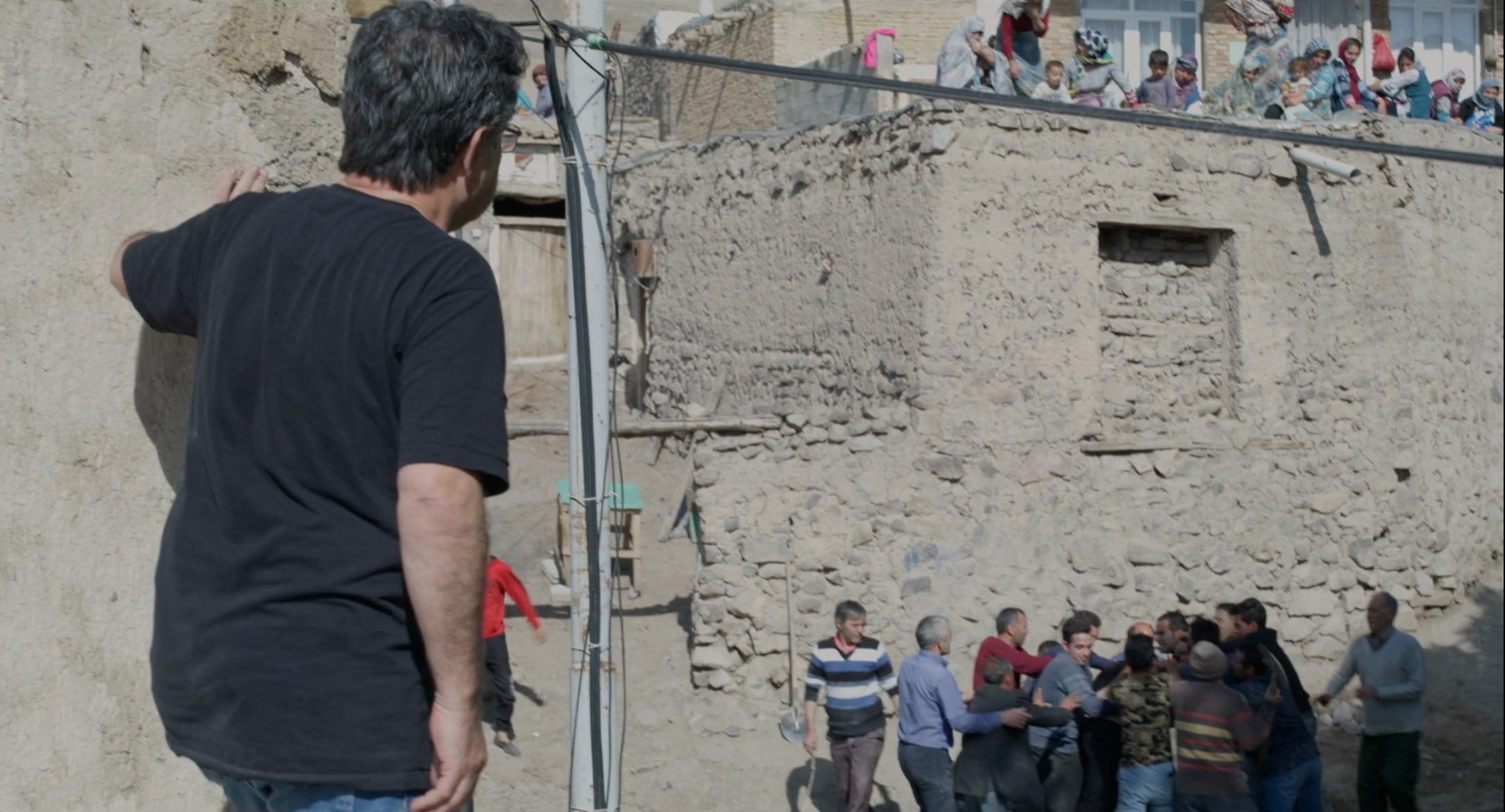
Late last year at the urging of many friends and film critics, I saw my first Jafar Panahi movie, the highly acclaimed masterpiece It Was Just An Accident. The film did everything a motion picture should: it took me into a new world I didn’t know about and brought me to emotional highs and lows as I experienced the story. I laughed, I cried, I was made to consider anew what I felt about justice and revenge. I walked out of the theater thinking not just “that was a good movie” but “that is why the concept of fiction exists”. I’d heard many good things about Panahi before, but I’d always shied away, thinking his films were cinema homework. Why watch a thinky drama in a foreign language when there are so many erotic thrillers I have yet to watch? I wasn’t afraid of it, but I also wasn’t drawn to it. Now, having seen what a master he is, my interest was piqued, and I wanted more. So just this week I threw on Panahi’s previous film: No Bears (2022)
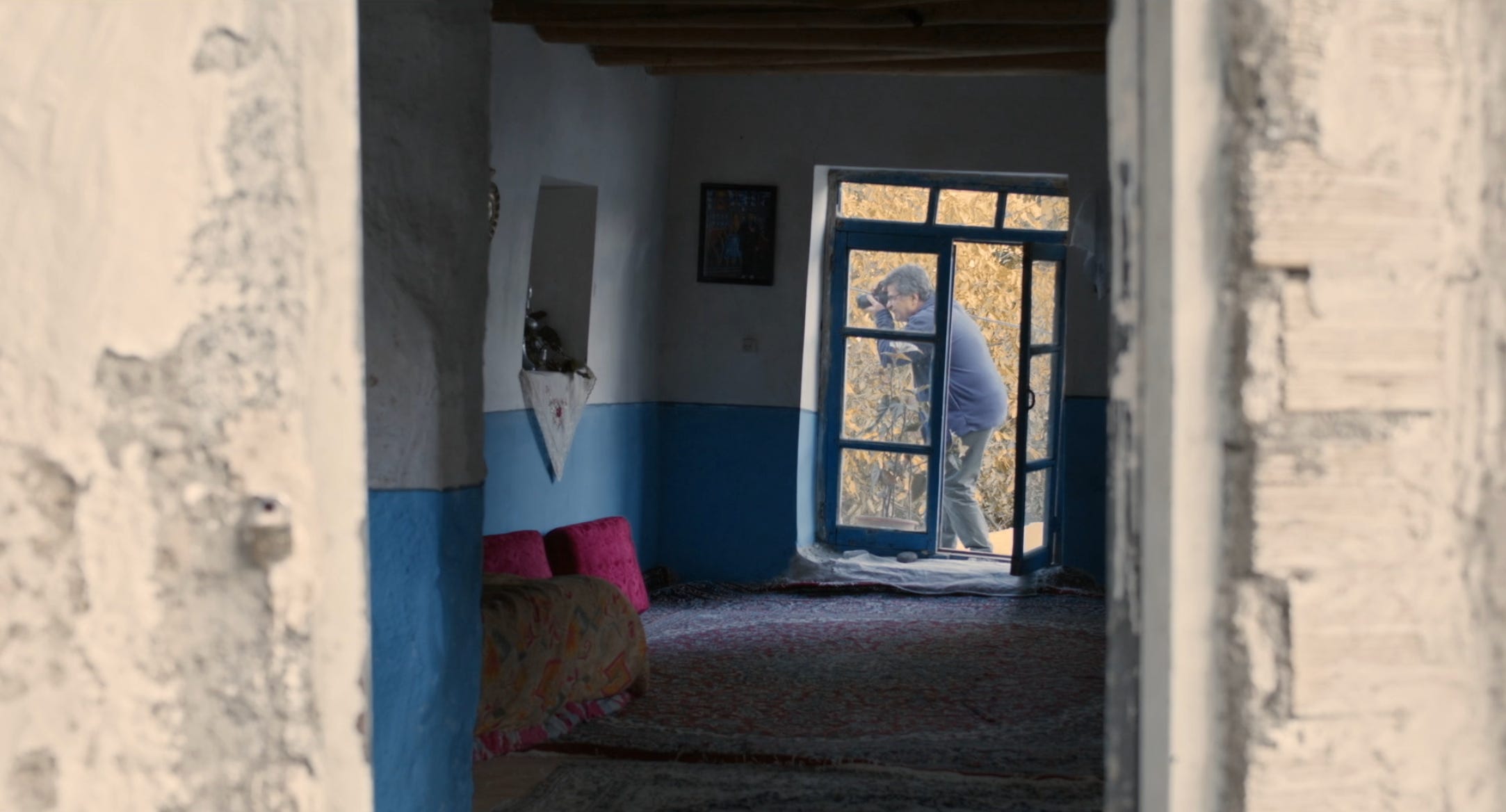
No Bears takes meta-filmmaking to a new level, in that it’s a film written and directed by Jafar Panahi, but it’s also about a fictional filmmaker played by Panahi also named Jafar Panahi1. The character Panahi has been kept from leaving the country by the Iranian government due to his films being considered potentially seditious. He’s in the midst of directing a docudrama about a pair of refugees fleeing Iran named Bakhtiar (Bakhtiar Panjeei) and Zara (Mina Kavani), who have snuck over the border to Türkiye and are seeking fake passports they can use to get to Europe. The character Panahi is in a small village just on the Iranian side of the border, directing the crew remotely through a Zoom window. When his internet connection craps out, he takes a walk through the village, taking photos. Unbeknownst to him, one of the photos he snapped may provide proof of a love affair between two villagers named Gozal (Darya Alei) and Solduz (Amir Davari), which threatens to tear apart the village’s social fabric.
A lot of writers like to put big central metaphors in their work, an easily understandable parable that speaks to how the characters interact or feel or about their fates. Most of the time, I find these irritating and unpleasant. The “Zen Master” speech from Charlie Wilson’s War comes to mind. I want to experience a story on my own terms, rather than having its meaning fed to me by its creator, but even a jaded cynic like me can be struck by a particularly poignant central parable. A great example comes early in the crime drama The Wire, where the midlevel gangster D’Angelo teaches his fellow drug dealers how to play chess. “How do you get to be the king?” asks Wallace, a low-level hustler, holding up a pawn. “It ain’t like that. The king stay the king” responds D’Angelo. It will shock no reader who hasn’t seen The Wire to learn that neither Wallace nor D’Angelo climbs to the top of their criminal organization.
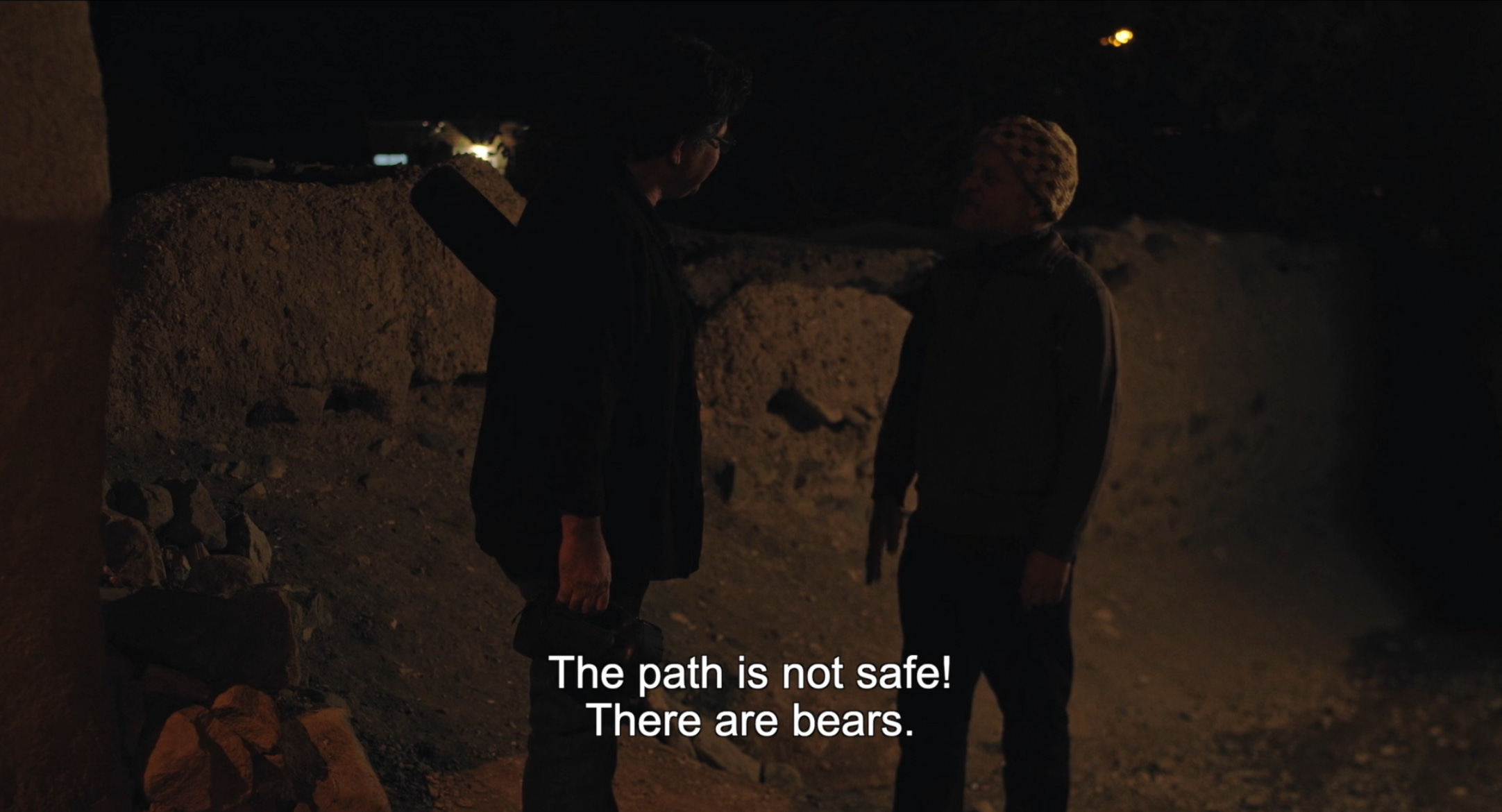
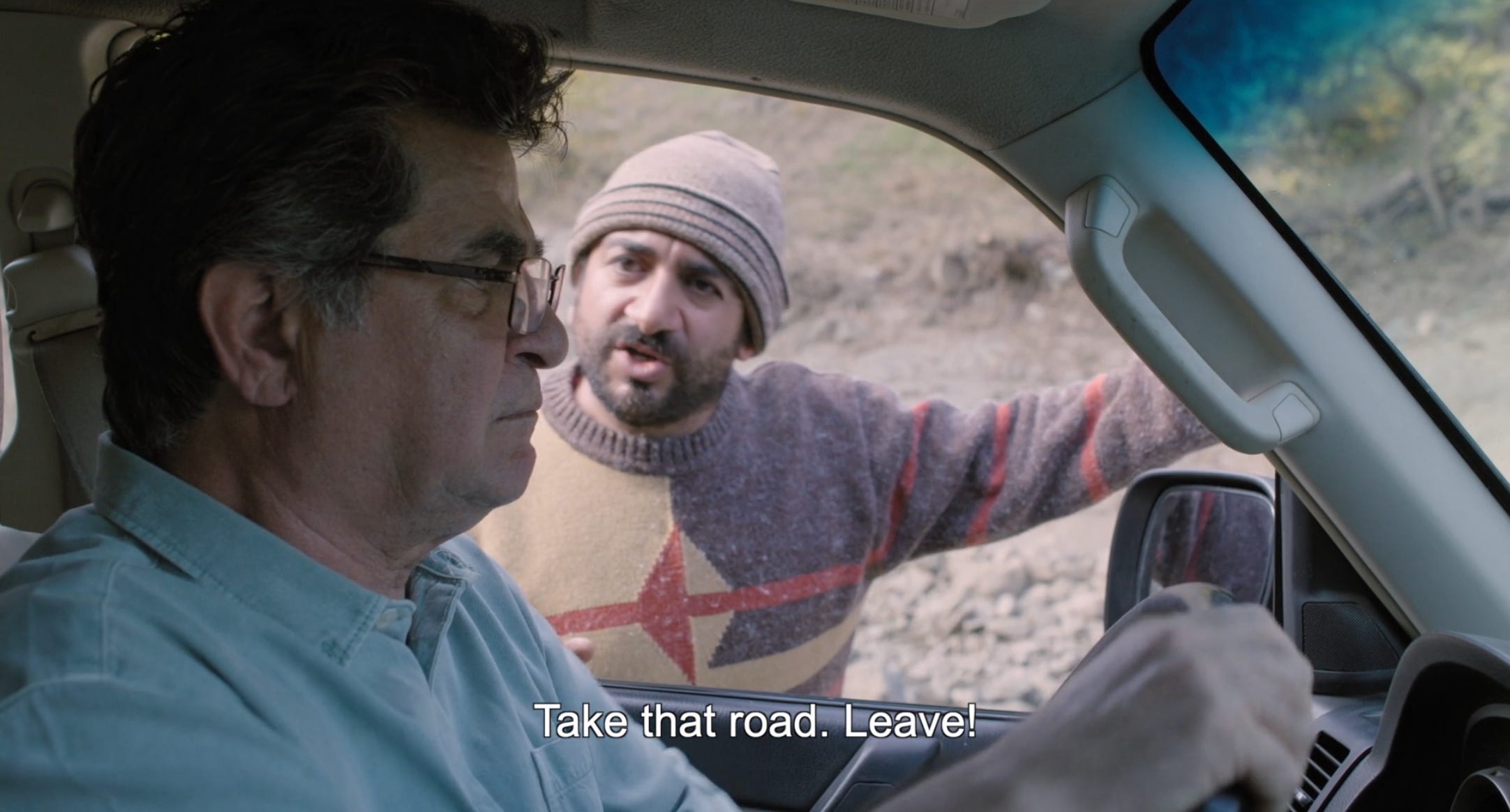
The director Panahi puts exactly such a central parable in No Bears. As the character Panahi is walking to a “swearing room” —a kind of quasi-courthouse where he will attest that he doesn’t possess a photo of the two villagers kissing— he’s stopped by a stranger who invites him to his house for tea. As Panahi says he has no time to waste on tea, the stranger tells him, “This path isn’t safe. There are bears. After a cup of tea, we’ll go together.” Over tea, the stranger tells him his thoughts on the swearing room and how Panahi should act when he arrives, and afterwards, he tells him to go on without him. “What about the bears?” he asks. “There are no bears, nonsense! Stories made up to scare us! Our fear empowers others. No bears! Just paper bears”.
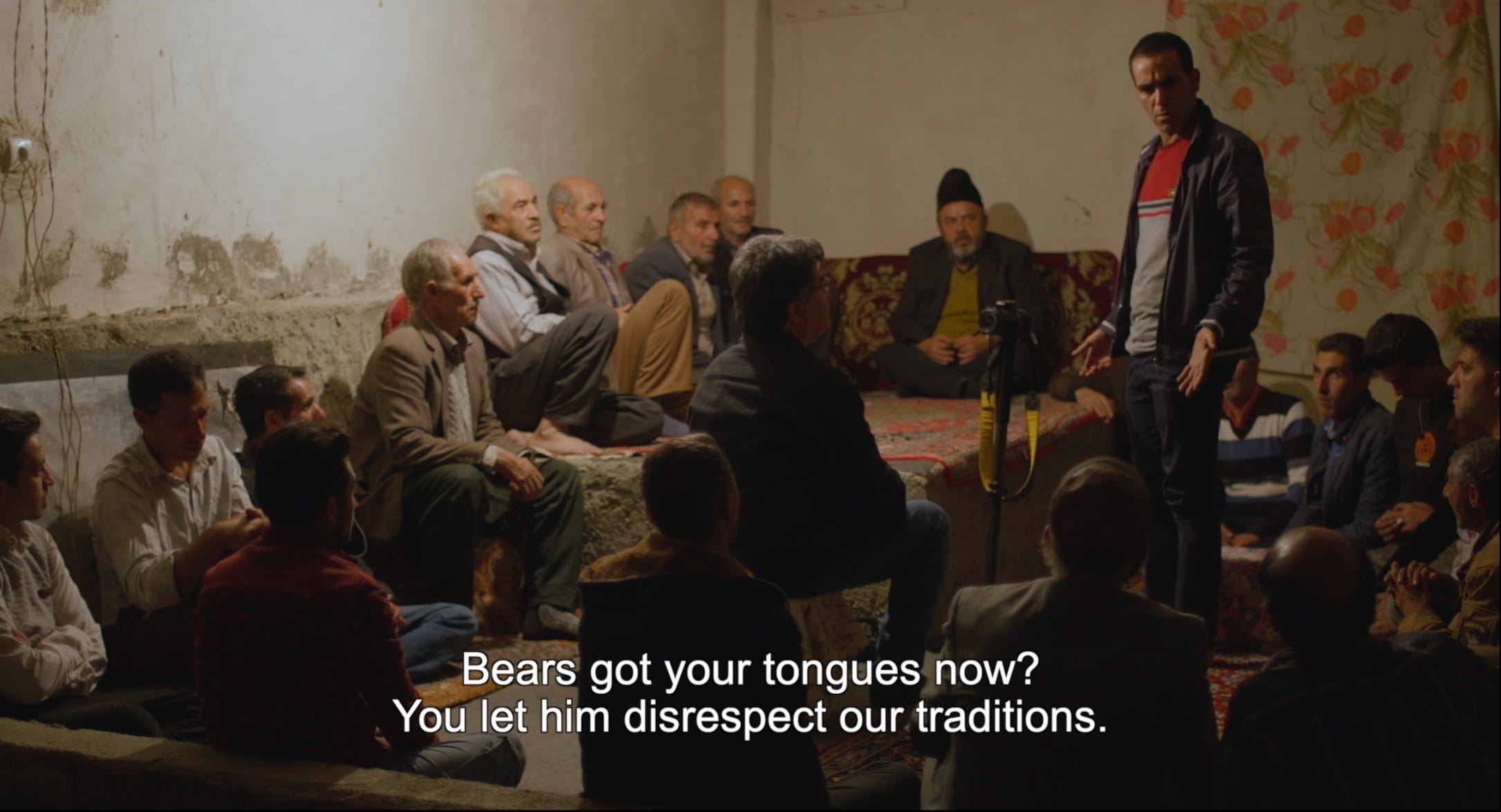
At its core, No Bears is a movie about these paper bears. The entirety of the problem that the character Panahi encounters with the villagers comes from an inscrutable superstition they have around women being de facto betrothed to another villager upon her birth by her umbilical cord being cut in another’s name. This is not an old Iranian custom. It does not even seem to be a custom in the Iranian-Azeri minority area where the character Panahi is staying. It is specific to one tiny village. In the “swearing room,” the character Panahi confesses that he finds the whole thing a little silly, but that statement is met with righteous anger, as though he had said “I honestly don’t get why kicking puppies is such a big deal”. The convention and superstition are incredibly narrowly focused and have no basis in objective reality whatsoever, but to the people of the village, it is incredibly real.
It’s not too hard to consider something else that has no objective basis in reality but that people consider incredibly real: international borders. The entire reason that the character Panahi is in the village in the first place is that he can’t leave Iran, and therefore can’t physically be present at the film shoot in Türkiye. In addition, the entire reason that the film shoot in Türkiye even exists is because Bakhtiar and Zara cannot simply go to France. There is no real physical barrier that keeps Bakhtiar and Zara from their goal. They have money for airfare, and even if they didn’t, there are bridges across the Bosphorus; there are roads through the Balkans. There is no physical barrier, only a paper one. They could get there were it not for a superstition believed by billions called the European Union border.
The fragility of this superstition is laid bare by the film itself, as the character Panahi is taken along a smuggling road by his Assistant Director to show him how easy it would be to sneak him into his film shoot. The character Panahi doesn’t dare, which is surprising given that the director Panahi has also been constrained by the Iranian government in real life. It’s just that his constraint isn’t against leaving the country, it’s against making films. The very document we’re viewing shows us that the director Panahi is willing to cross a line that his character doesn’t. The character Panahi is constrained by his fear of a paper bear. While on the smuggling road, they stop on a hilltop and look from afar at Turkish landscape and the town where Bakhtiar and Zara are hiding. “Where is the border?” he asks, and when his AD answers, “You’re standing on it,” he begins hyperventilating and stumbling backwards. The notion that he has transgressed even a footstep terrifies him, despite a vanishingly small chance that he would ever experience a consequence for this transgression.
Spoilers for No Bears and discussions of self-harm to follow
Of course, these nonexistent things can harm people just as much as any bear attack. At the film’s close, several subjects of Jafar Panahi’s lens — the migrant Zara and the lovers Gozal and Solduz —die due to their respective paper bears. Zara cannot find a way for both her and Bakhtiar to get out of Türkiye, and she cannot imagine a life without him, so she drowns herself in a nearby lake. Gozal and Solduz see the consequences of their affair spiralling out of control in the village and attempt to flee and get shot crossing the border. The film’s final harrowing shot consists of Jafar Panahi sitting in his car as he leaves the village, pondering the lives lost over this nonsense, these paper bears.
The border didn’t drown Zara, though. The border didn’t shoot Gozal and Solduz. People who believed in the power of the border performed these actions. History is full of people acting on things that aren’t real because they believe in their power, which in turn renders these paper bears just as deadly as real ones. Witchcraft isn’t real, and yet the witch trials of Loudon in 1634 or Salem in 1692 absolutely had intense and real consequences. Every deep examination of “race” demonstrates its lack of biological reality, but still, this particular paper bear is responsible for countless lynchings, pogroms, and genocidal actions.
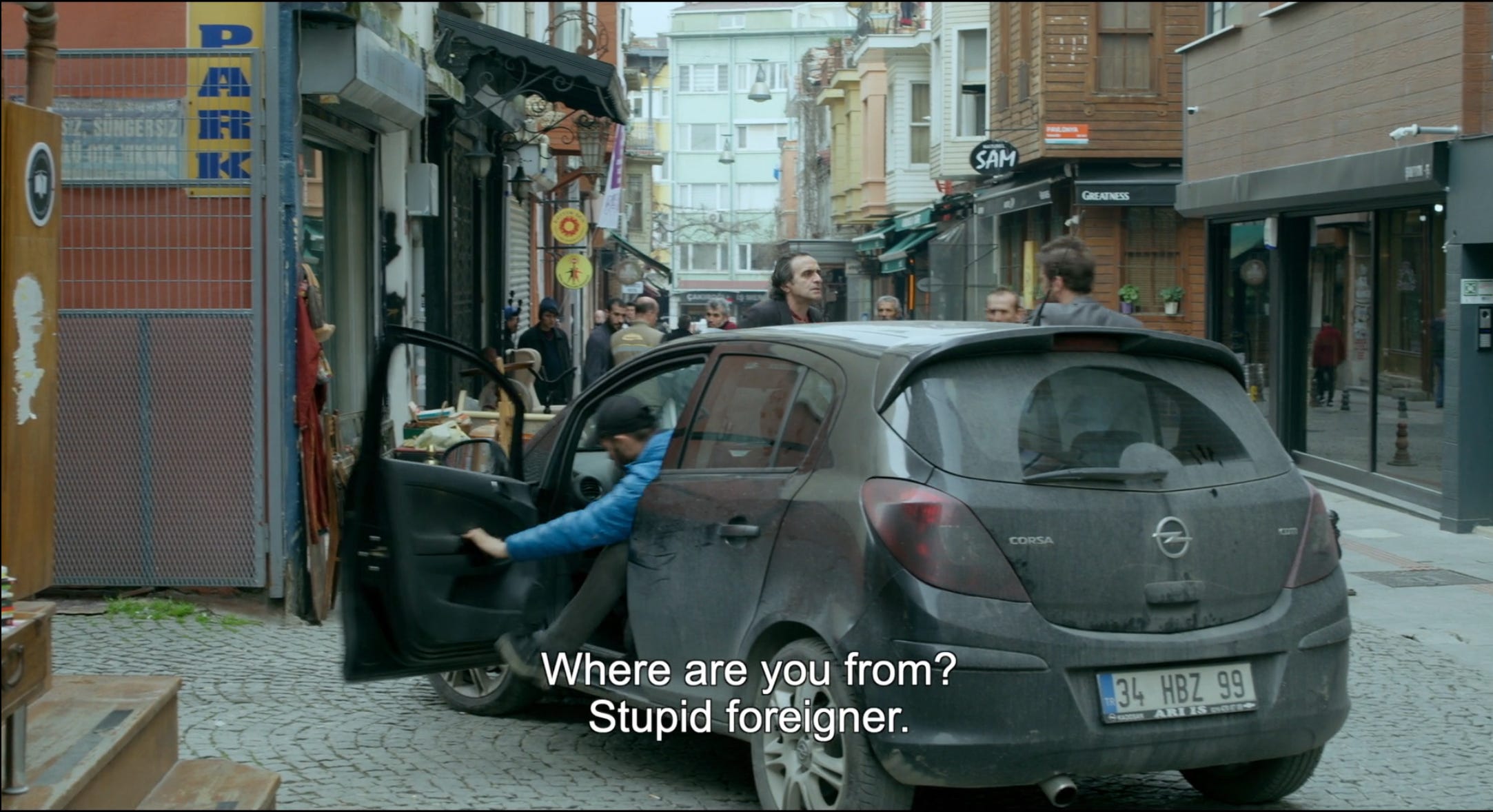
As I write this, it is February of 2026, and I am in Minneapolis, Minnesota. While there has been little action in my neighborhood compared with last month, my neighbors and I still walk around with whistles around our necks, our necks on a swivel. If I go to the shopping center around the corner that has a panaderia and a pupuseria and a clothing store selling camisas de vaquero, I need to be let in by a doorman. There’s a building under construction a dozen blocks away that hasn’t been worked on for two months because no one wants to be both outside and visibly Latino for long stretches of time. We remain afraid and alert. The reason for this fear? An imaginary line on the ground in the Sonoran desert, a line that, if you stood on it, you would not even know existed. I want to grab these men who enforce the reality of this line by the shoulders and say, “Don’t you get it? There’s no bears! It’s not real! We don’t need to do this.” We don’t believe in witchcraft anymore, but the superstition of borders — the paper bear of this imaginary line in the sand — is still real enough to kill you.
For the remainder of this piece I will refer to the actual human being who directed No Bears as “the director Panahi”, and the character he plays in No Bears as “the character Panahi”