
Eastern Promises
September 14, 2007, The Final Year In Cinema Week 37

If you speak the words “David Cronenberg” to someone well versed in cinema history, certain images immediately come to mind, gross ones. Cronenberg’s best known films like Videodrome (1983), The Fly (1986) and Naked Lunch (1991) are full of horrifying-yet-fantastical images of people turning into machines, people turning into bugs, and machines turning into bugs. If you’re watching a David Cronenberg film, there’s a good chance that something upsetting is going to happen and that upsetting event is going to be disconnected from reality. “What if a guy lost his humanity as he turns into a bug” is a great premise for fiction, a way to tell a compelling story, and also something that I will never ever have to think about happening in real life.
At the turn of the 21st century, Cronenberg stepped back from his extremely bizarre and disturbing “what if your best friend was a typewriter bug man” films to tell stories that were more grounded in reality. I am a massive scaredy cat about body horror stuff, so I was very interested to see what Cronenberg could do as a skilled director filming material that wasn’t about the terrifying connection of the biological to the technological. I went into Eastern Promises thinking that I was going to have a good time with a popcorn-eating mob film like The Departed (2006) or Miller’s Crossing (1990). Unfortunately when you’re David Cronenberg you’re really good at making disturbing things disturbing, and when those disturbing things are realistic, it only makes for a more upsetting experience.
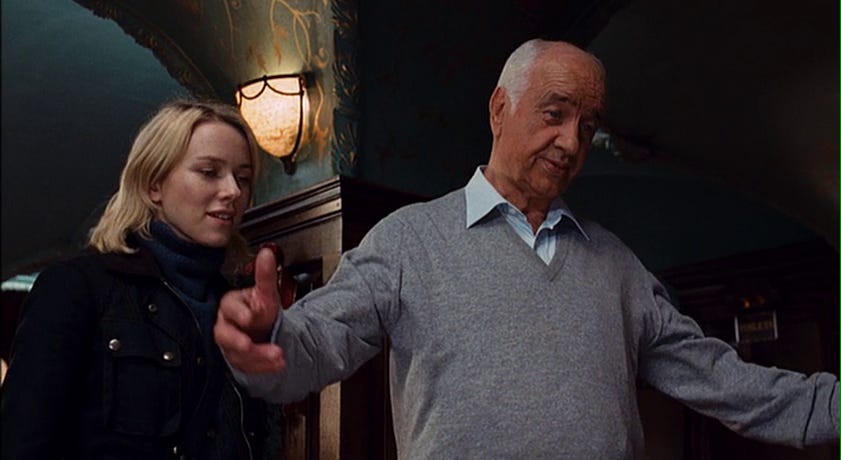
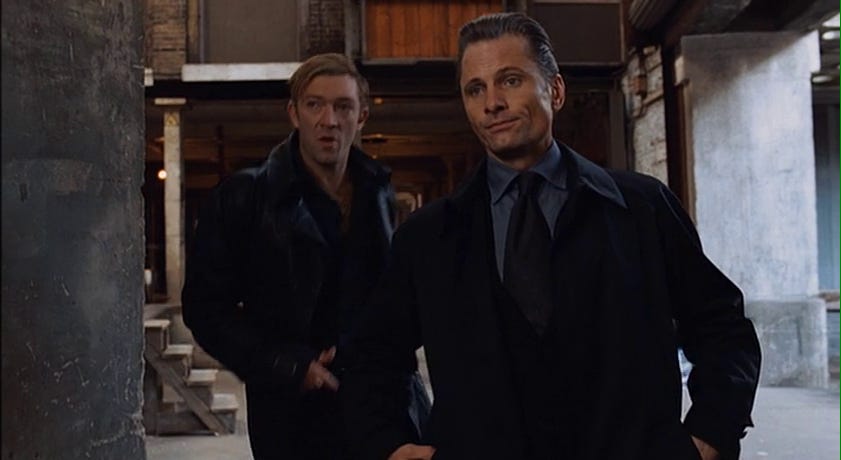
Eastern Promises is centered around Anna (Naomi Watts), an English midwife of Russian ancestry and Nikolai (Viggo Mortensen), a fixer and driver in the local Russian mob. Anna has just helped deliver a child from a nameless woman who died at her hospital and seeks to find the mother’s identity and potential surviving family members, which leads her to a Russian immigrant organization run by Seymon (Armin Mueller-Stahl), which unbeknownst to her is a front for mob activities. In the meantime, Seymon’s son Kirill (Vincent Cassel) has gotten himself into a mess of trouble due to an unauthorized hit of a Chechen mob rival and has left his family open to retaliatory violence, and have engaged Nikolai to help clean up the mess. Through the course of their respective journeys, Nikolai and Anna realize that they have more in common than they thought, realizing that Seymon needs to be brought down.
The film begins with the gangland killing of Kirill’s chechen rival in a barbershop. The killing is carried out by the barber’s son who appears to have a diminished mental capacity of some kind. To the audience, it comes out of nowhere. After two minutes of barber-and-client small talk about how useless the barber’s son is, the barber Azim thrusts a razor into his son’s hand and shouts “take the fucking ustra and kill this Rus!” Within seconds he is using the razor to awkwardly saw at the chechen’s throat as blood sprays across the barber shop. The moment exists as a kind of thesis statement to the film. In this world life is cheap, killings are personal, and they are quiet and terrifying.
Everything about the film that follows as the audience learns about Seymon’s criminal enterprises hammers these points home. As Anna learns about the history of her mystery baby’s dead mother, she learns that she was once a young woman in Ukraine who yearned to come west and learned of an organization that would help her get to London and get set up with a job. What she didn’t realize was that the organization was Seymon’s organized crime syndicate, and that the “getting to London and being set up with a job” was more “being trafficked to London and being forced into sexual slavery”. Seymon’s reach is clearly quite large and he’s clearly done this same playbook with dozens of women, but by focussing on Anna and her quest to find a newborn’s relatives it becomes immensely personal, and thus all the more horrifying.
Every subsequent death in the film is felt this way. More throats are slit, more men are stabbed, and at one point the newborn at the center of all the action is nearly drowned. When we watch Scarface (1983), Tony Montana’s killings are cartoonish and broad, mowing down dozens of people we see for a few frames at a time. You can understand that he’s a monster, but it’s tough to really feel it. Watching Eastern Promises, you’re constantly reminded that humans are fragile bags of water and meat, and that a well placed blade can send you to your maker with a determined enough hand. The personalization of the violence makes you feel it in your bones.
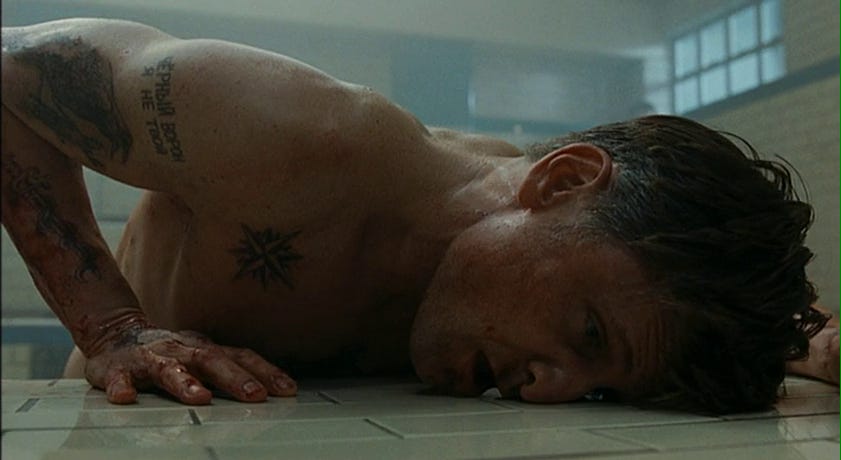
Nowhere does Cronenberg get this across better than with the film’s famous bathhouse battle scene. Through the film, we learn that the Russian mob uses tattoos to convey rank and status, and therefore business is often conducted in the steam room of the bathhouses, as it allows for all interested parties to know exactly who they’re dealing with. As a freshly made gangster, Nikolai has just had stars tattooed on his shoulders and knees identifying him as a member of the vor, which also lets him be identified as the fall guy for the chechen’s death during a bathhouse meeting. Two assassins enter the steam room and for five excruciating minutes we see Nikolai struggle for his life with literally nothing but his own body to protect him. Nikolai’s strength and vulnerability are both on display and are captivating and terrifying at once. The scene is exciting, but in the same way that nearly tripping and falling over a cliff is exciting. It’s a thrilling moment but it’s also one that reminds us that we are seconds away from death if the chips fall the wrong way.
I went into Eastern Promises thinking that I’d have a fun time watching a movie for once while watching a David Cronenberg film rather than cringing while watching someone have simulated sex with a leg wound. I came out of it more freaked out than I ever have, because when horror isn’t fantastical, it’s profoundly real.
Rating ★★★★☆ The movie is terrifying and horrible but is also fascinating and compelling. Folks, David Cronenberg really knows how to make movies. Without his filmcraft I’m not sure I could bear watching what he wants to put on screen.
Economics: Eastern Promises opened in limited release in 15 theaters on September 14, 2007, where it was number 21 at the box office just behind I Now Pronounce You Chuck & Larry in its 9th week of release. It would eventually go wide and make $56 million at the global box office against a £25 million ($50 million USD) budget. This would be little enough revenue to make the film lose money, but for the fact that the film was an early success on Netflix. Having been a mild commercial disappointment Netflix was able to purchase this new thing called ”streaming rights” for the film in 2008. Word of mouth soon spread that Netflix’s new “watch now” service was a place where you could instantly watch films that were maybe a little less well known but were critically acclaimed. Now it’s a place where you can experience 30 different flavor of Lifetime Original Movies.
Other 2007 films released this week:
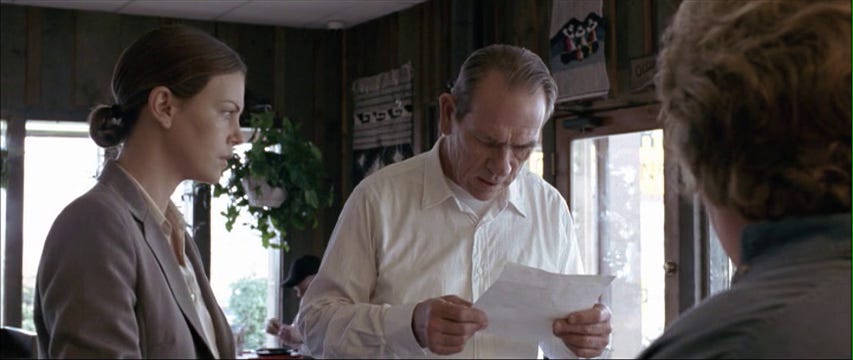
In The Valley of Elah: Most Tommy Lee Jones performances ultimately breaks down to him wishing someone would tell him what the hell is going on (click that link, you won’t be sorry). In The Valley of Elah is no different. Tommy Lee Jones finds out his son — freshly returned from active duty in Iraq — has gone missing from his base. He and a local cop (Charlize Theron) try to get some answers from other soldiers who are profoundly uninterested in talking about modern military culture. Remarkably, it’s a film with Tommy Lee Jones, Josh Brolin, Barry Corbin, and Kathly Lamkin set in the American Southwest from 2007 that isn’t No Country For Old Men. TLJ’s performance is great (he got an Oscar nod for it, weirdly, but not for No Country), the rest of the movie is… fine. Kind of a bleaker dollar store version of A Few Good Men (1992) ★★★☆☆
click what link 🥺
Oh man. I saw this in the theaters, and the violent culmination of the bathhouse fight is one of the two times I’ve turned away from a screen (the other was in Pink Flamingoes). This movie, and a few others, convinced me to take a shot at filmmaking. Nearly two decades later and I don’t think I’ve come close, but that’s ok. Stellar movie. Rough, though. And damn Viggo transforms in this.